tips
Story Arcs Explained for Parents: The Secret Behind Great Stories
From The Lion King to Harry Potter — almost every beloved story follows one of four classic arcs. Learn what they are and how to use them when writing for your child.
The Secret Behind Every Great Story
Have you ever finished a movie and thought: "That felt so satisfying" — even though you can't quite say why? Or read a picture book to your child at bedtime for the hundredth time, and still felt something by the end?
That feeling has a name. It's called narrative arc — and almost every story your child has ever loved follows one.
Whether it's The Lion King, Finding Nemo, Harry Potter, or the simplest picture book from your local library, there's a hidden skeleton underneath that makes the story feel right. Once you know it, you'll see it everywhere. And even better: you can use it yourself, the next time you want to tell your child a little story at bedtime.
What Is a Story Arc?
A story arc is the shape of a story over time — how it rises, shifts, and resolves. Think of it like the arch of a bridge: the story starts at one point, rises through conflict and tension, and comes back down at a satisfying conclusion.
The concept goes back thousands of years. The ancient Greeks called it mythos — the structure of plot. Aristotle wrote that every good story needs a beginning, middle, and end. Over the centuries, storytellers, playwrights, and scholars refined this idea until they noticed something remarkable: the same shapes kept appearing across cultures and genres, from ancient myths to modern blockbusters.
In 1949, American writer Joseph Campbell described the most famous version in The Hero with a Thousand Faces. He called it the monomyth or "Hero's Journey" — a pattern so universal he found it in stories from ancient Greece, India, indigenous America, and medieval Europe. Hollywood uses it to this day.
The Four Great Story Arcs
For children's stories in particular, most narratives can be grouped into one of four core arcs. Each has a distinct rhythm, a distinct emotional payoff, and a rich history in both literature and film.
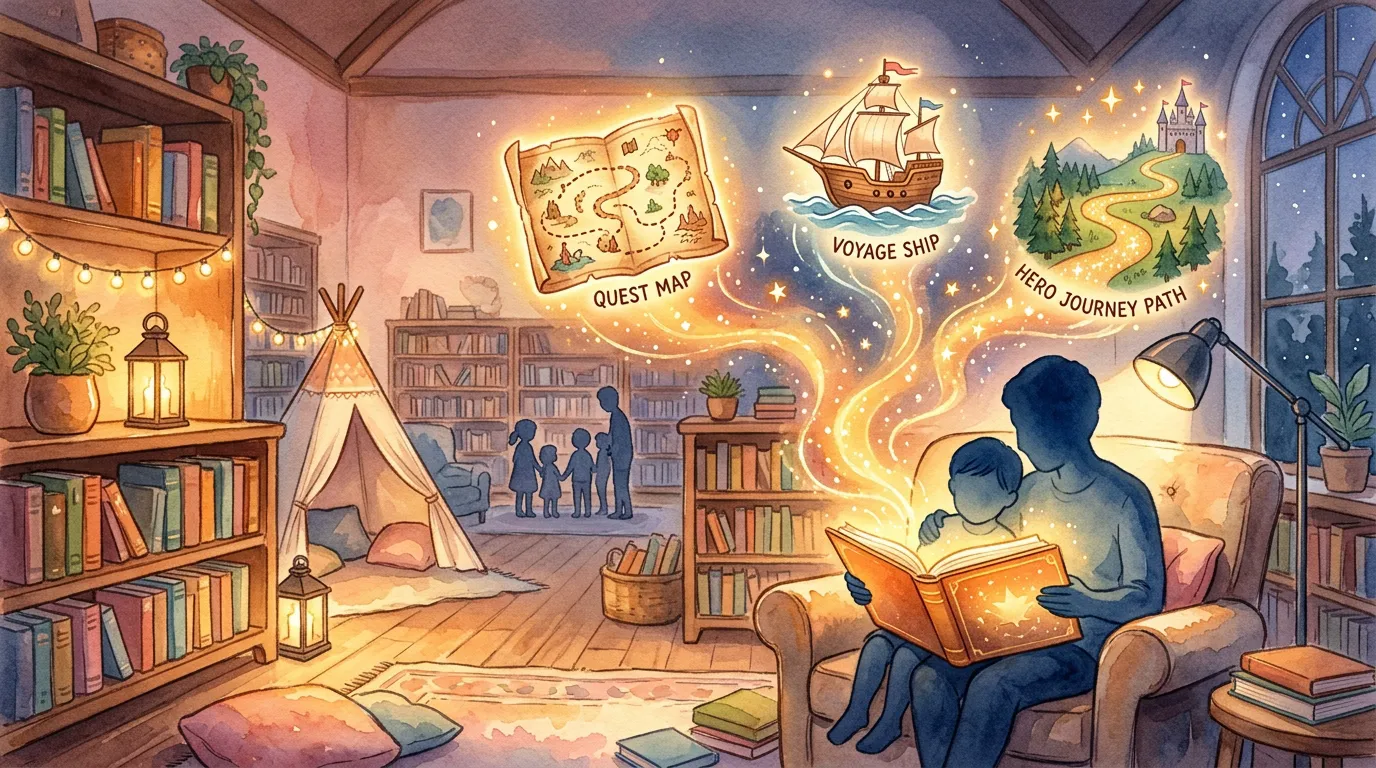
1. 🗺️ The Quest (Modular Adventure)
The shape: A hero works through a series of mini-goals or stops, each one adding progress toward one clear final resolution.
The feeling: Momentum. The joy of small wins building up to something big.
Classic examples:
- The Wizard of Oz (1939) — Dorothy travels through Oz, collecting companions at each stop
- Finding Nemo (2003) — Marlin crosses the ocean step by step, station by station
- Peppa Pig — nearly every episode has Peppa tackle a small, sequential challenge
Historic roots: Quest arcs dominated medieval literature (the Arthurian knights, Dante's Inferno) and were the spine of the great epic poems like The Odyssey. In the 20th century, they flourished in road-trip films and the serialized adventure stories of the 1930s radio era.
For children: Works beautifully for ages 3–7. The clear structure — "first we do this, then this, then this" — mirrors how young children process sequences. Each mini-win keeps engagement high.
Use it when: Your child is curious about a journey, a collection, or a series of places. "Let's go on a treasure hunt where each clue leads to the next..."
2. ⚓ Voyage and Return
The shape: Leave a familiar place → face rising obstacles in an unfamiliar world → return home safely, changed by the experience.
The feeling: Relief. Warmth. The comfort of home seen with fresh eyes.
Classic examples:
- The Hobbit / Lord of the Rings (Tolkien, 1937–55) — Bilbo and Frodo leave the Shire and return transformed
- Where the Wild Things Are (Maurice Sendak, 1963) — Max sails to the land of wild things and comes back to dinner still hot
- Alice in Wonderland (Lewis Carroll, 1865) — Alice falls into Wonderland and wakes safely in her sister's arms
- Moana (2016) — leaves the island, faces the ocean, returns as chief
Historic roots: This is perhaps the oldest arc in human history. It appears in The Odyssey (~800 BC), in fairy tales collected by the Brothers Grimm (~1812), and in Aboriginal Australian Dreamtime stories. It dominated Romantic-era literature of the early 19th century, when writers were fascinated with journeys into nature and the human psyche.
For children: Profoundly reassuring. Children process fears and big emotions by going "out there" symbolically and returning safely. It's why Where the Wild Things Are remains one of the bestselling children's books of all time.
Use it when: Your child is anxious about something new — starting school, a move, a new sibling. "Imagine you traveled to a faraway land, and everything felt strange... but then you found your way home."
3. 🌤️ Everyday Challenge (Overcoming the Problem)
The shape: Start with a relatable everyday problem → it escalates through small setbacks → resolve with practical action, warmth, and confidence.
The feeling: "I can do it." Normalcy restored, with a sprinkle of pride.
Classic examples:
- The Very Hungry Caterpillar (Eric Carle, 1969) — a small creature faces need, eats through everything, and transforms
- Bluey (2018–) — nearly every episode centers on a small, real-world challenge: sharing, jealousy, not getting what you want
- Paddington (2014 film) — a small bear navigates an unfamiliar household with patient, cheerful persistence
- Knuffle Bunny (Mo Willems, 2004) — a lost toy, rising panic, resolution through parental teamwork
Historic roots: This arc emerged strongly in 20th century realist children's literature — the genre that replaced Victorian morality tales with emotionally honest stories about real childhood struggles. Authors like A.A. Milne (Winnie the Pooh, 1926) and Dr. Seuss perfected it. In film, the Pixar formula often relies heavily on this arc nested inside larger ones.
For children: Gold for toddlers and early schoolers. It validates their emotional experience ("It's okay to feel frustrated!") while modeling that problems can be solved.
Use it when: Your child had a hard day — a fight with a friend, something didn't go their way. Make the hero have the same problem and find a small, warm solution.
4. 🌟 The Micro Hero's Journey
The shape: Begin in ordinary comfort → face a meaningful test that requires inner courage or growth → end with an earned confidence shift, back in the same world.
The feeling: "I am a little bigger than I was before." Quiet pride.
Classic examples:
- The Lion King (1994) — Simba starts happy, loses everything, grows into his true self
- Harry Potter (1997–) — a quiet boy in a cupboard discovers his power and earns his place
- Brave (2012) — Merida resists change, faces consequences, earns wisdom
- The Gruffalo (Julia Donaldson, 1999) — a small mouse uses wit over fear and walks home more confident
Historic roots: This is the arc Joseph Campbell mapped in 1949, and it predates written language — appearing in ancient Egyptian myths, Greek hero tales, and the religious narratives of virtually every culture. In the 1970s and 80s, it became the explicit blueprint for Star Wars (George Lucas studied Campbell directly), and industry story consultants like Syd Field and Christopher Vogler formalized it for Hollywood.
For children: Particularly powerful for ages 5 and up. It mirrors the psychological challenge of individuation — growing into your sense of self — which is central to early childhood development.
Use it when: Your child is facing something that requires courage — a first day, a new skill, standing up for themselves. Let the hero face the same fear and come back just a little bit taller.
How to Spot the Arc in Your Favorite Films
Once you know the arcs, movie nights become fascinating. Here's a quick cheat sheet:
| Film | Dominant Arc |
|---|---|
| Finding Nemo | Quest |
| The Wizard of Oz | Quest + Voyage & Return |
| Moana | Voyage & Return + Micro Hero's Journey |
| The Lion King | Micro Hero's Journey |
| Bluey (any episode) | Everyday Challenge |
| Harry Potter | Micro Hero's Journey |
| Alice in Wonderland | Voyage & Return |
| Paddington | Everyday Challenge |
| The Gruffalo | Micro Hero's Journey |
| Toy Story | Quest + Everyday Challenge |
Most great stories layer arcs — the outer story follows one shape, while character subplots follow another. But there's always a dominant spine.
Writing a Story for Your Child? Start with the Arc.
You don't need to be a professional author to tell a story that resonates. You just need the right shape.
Here's a simple way to get started:
Step 1: Pick an arc — Which feeling do you want to give your child tonight? Momentum (Quest)? Warmth and home (Voyage)? Confidence (Challenge or Hero)?
Step 2: Anchor it to something real — Is your child obsessed with dinosaurs? A small city? Their best friend from school? Drop that thing into the arc.
Step 3: Set the problem — Every arc needs a problem. It doesn't have to be big. Lost mittens. A shy new friend. A bridge that needs fixing.
Step 4: Let them solve it — The hero should resemble your child. The solution should feel within reach.
Step 5: End with warmth — Come back to safety, home, confidence. The resolution doesn't need to be dramatic. It needs to feel right.
Or Let Kreativbuch Do It For You
If the blank page feels daunting, that's completely normal. Even professional authors stare at it.
That's why we built Kreativbuch — to give parents a simple way to create personalized, beautifully illustrated storybooks for their children, without needing to be a writer. You pick the theme, the characters, the setting, and the values you want the story to carry. Our AI uses exactly these classic arc structures to weave your child into a story that feels genuinely meaningful — not like a template, but like a real book.
Every story we generate follows one of these four arcs, chosen based on your child's age and the emotional tone you're looking for. The result is a full, illustrated storybook — ready to read tonight.
Want to try? Create your child's first personalized story — it takes about five minutes, and the result might surprise you. 🌟